Replacing Paper Timecards
Build a Timecard Process Payroll Can Trust
Construction timecard software works best when the field entry, supervisor review, and payroll export follow one defined process. Set the rules first, then make the common action easy.
Capture time where the work happens
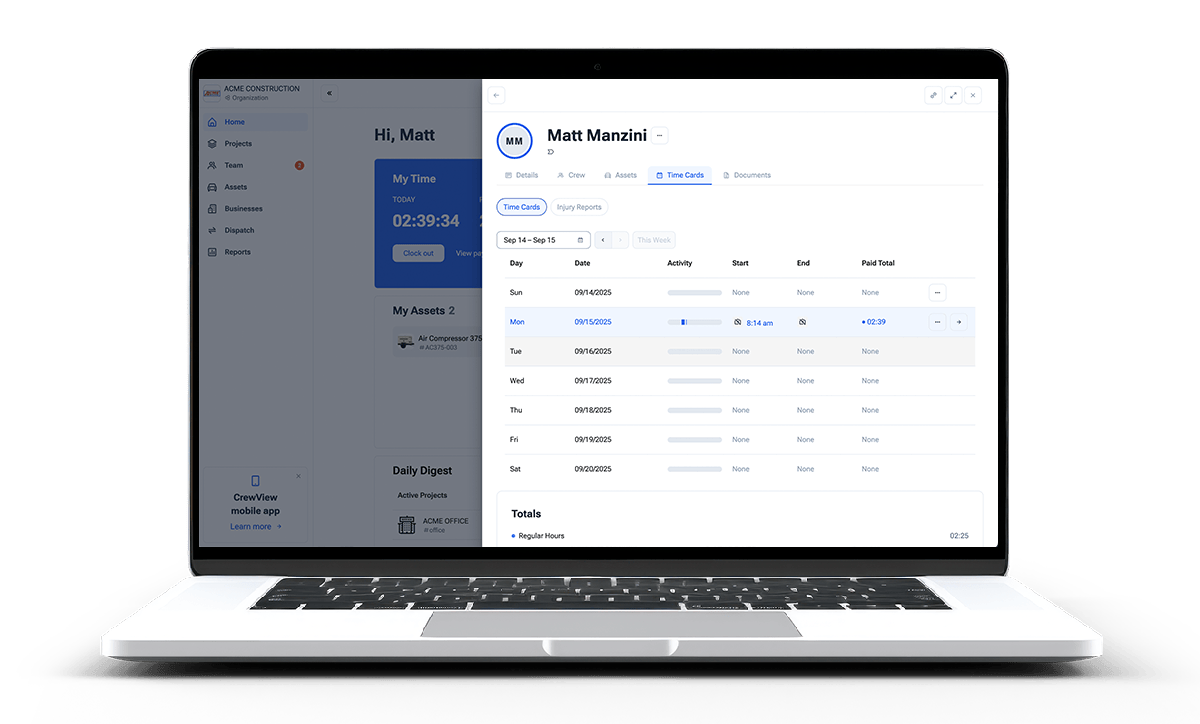
Ask employees to record the start and end of work from the field instead of rebuilding the day on Friday. Keep the required steps short enough to use at the beginning of a busy shift. CrewView records the employee, time, location, project, and task in one entry. That context gives supervisors a better starting point than a handwritten total and helps the company place labor on the work that received it.
Use project and task names the crew knows
A long accounting code may make sense to the office and still confuse the employee choosing it on a phone. Present projects and tasks with recognizable names, remove old options, and explain how to record a move between jobs. Better choices reduce corrections and give managers more dependable labor detail for job costing, production review, and future scheduling.
Give supervisors an exception-based review
Do not ask a supervisor to investigate every ordinary entry. Focus attention on missing punches, unexpected jobs, overlapping time, unusual hours, and manual corrections. Compare the timecard with the crew assignment and project work, then ask the employee when the records do not match. A consistent review protects accurate pay while catching process problems before the pay period closes.
Keep one approved record for payroll
Define who approves each employee or crew and when approval is due. After the supervisor resolves exceptions, export the accepted hours rather than entering them again. CrewView preserves the project and task detail behind the total, which gives payroll a clean record and gives project managers useful labor information without asking either team to maintain a separate spreadsheet.
Test the workflow through one full pay period
Pilot the process with a supervisor, a field crew, and the payroll person who receives the final export. Follow normal shifts, job changes, missed punches, corrections, approval, and payroll delivery. Ask where the employee hesitated and where the office still rebuilt information by hand. Adjust the policy and project list before moving every crew into the system. A complete pilot catches more problems than a clock-in demonstration.